
With the 2026 World Cup on the horizon, I keep coming back to the same truth: World Cup finals are decided by moments, not systems. As I rewatched the footage and read through the old match reports, I realised how many of those moments have been shared across generations. Here is my countdown of the ten greatest goals ever scored in the last match of football’s biggest tournament.
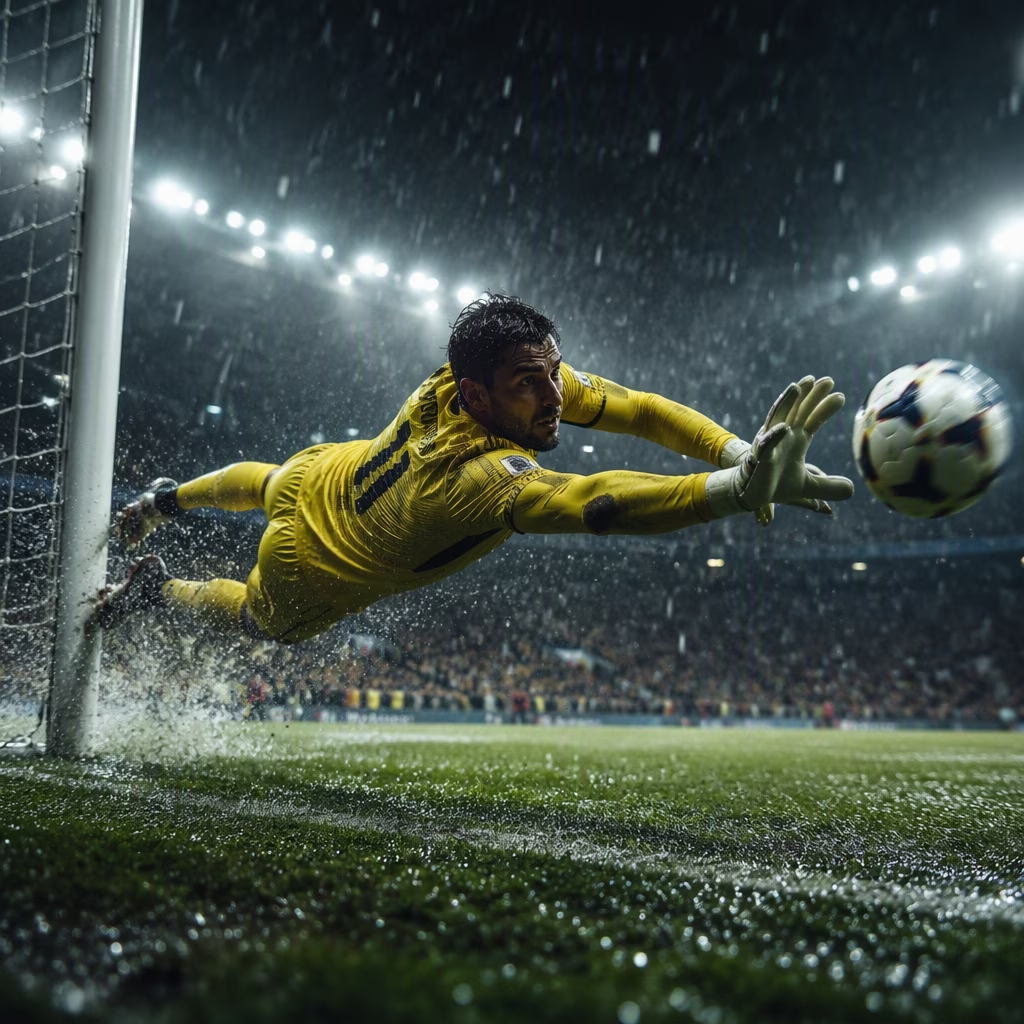
Some of these goals are famous for technique, others for emotion, and a few for sheer timing. But all of them have become part of the game’s permanent memory.
10. Zito — Brazil 3-1 Czechoslovakia, 1962
Brazil did not have Pelé by the time the final arrived in Chile, yet they still found a way. After falling behind and drawing level, Brazil took the lead through Zito. Amarildo burst down the left, chopped inside with real intelligence, and lifted a measured chip toward the back post. Zito arrived on time and headed the ball into the net. For me, it was not the most spectacular goal on this list, but it was a perfect example of a team finding a solution when its biggest star was absent.
9. Silvio Piola — Italy 4-2 Hungary, 1938
Italy won their second World Cup with a 4-2 victory over Hungary, and Piola’s first goal captured the confidence of that golden Italian side. Three attackers seemed to tease the Hungarian defence before the ball arrived at Piola’s feet. From close range he lashed it into the top corner with no backlift and no hesitation. Piola scored twice that day, but this first strike remains my favourite snapshot of pre-war Italian dominance.
8. Jorge Burruchaga — Argentina 3-2 West Germany, 1986
West Germany’s entire plan in the 1986 final was built around silencing Diego Maradona. For most of the match Lothar Matthäus did exactly that. But Maradona needed only a second. With the game tied and tension at its peak, he slipped a surgical pass through to Burruchaga, who raced towards goal and poked the ball past Harald Schumacher. It was not Maradona’s famous solo run from the quarter-final, but it was far more important, because it delivered the trophy.
7. Mario Götze — Germany 1-0 Argentina, 2014
I still remember the quiet before the explosion. André Schürrle swung a deep cross, Götze controlled it on his chest, and in the same flowing motion he volleyed across Sergio Romero into the far corner. The technique was outrageous because he made two difficult touches look effortless. That goal defined Götze’s career in an instant, though he later admitted the weight of expectation was not easy. In that moment, though, he was immortal.
6. Marco Tardelli — Italy 3-1 West Germany, 1982
Sometimes the celebration is the story. Tardelli’s goal was a sweetly struck half-volley from outside the area, but it was his wild, tearful scream as he ran toward the bench that made it eternal. No choreography, no planned routine, just raw emotion bursting out of a man who understood exactly what it meant. Italy went on to win their third World Cup, and that image remains one of the tournament’s most powerful memories.
5. Andrés Iniesta — Spain 1-0 Netherlands, 2010
This was a final remembered for its physicality, but Iniesta supplied the class to decide it in the last minute of extra time. Earlier in the move he had already played a glorious backheel, and when the ball came back to him inside the area, he controlled it with perfect poise. Then, rather than panic, he set himself and volleyed beyond Maarten Stekelenburg. It gave Spain their first World Cup and gave me one of those rare moments when beauty and importance arrived together.
4. Zinedine Zidane — France 1-1 Italy, 2006
Zidane’s final World Cup final is clouded by his red card, but his opening goal from the penalty spot was pure audacity. With Gianluigi Buffon in goal and the world watching, Zidane chipped a Panenka down the middle. The ball struck the crossbar and bounced just over the line before coming back out. Brave, brilliant and slightly fortunate, it was a moment only a player with Zidane’s nerve would even attempt in football’s biggest fixture.
3. Pelé — Brazil 5-2 Sweden, 1958
Pelé was just 17 years and 239 days old when he scored in the 1958 final, becoming the youngest final scorer in history. The goal itself was outrageous. He chested a drilled pass, lobbed the ball over a defender’s head, and then, as it dropped, unleashed a crisp volley into the corner. That blend of imagination, balance and finishing announced the arrival of the greatest player I have ever studied.
2. Geoff Hurst — England 4-2 West Germany, 1966
‘They think it’s all over — it is now!’ Those words still echo through English football. Hurst’s second goal may always be debated for the goal-line incident, but his third was beyond dispute. With the final seconds ticking down, he simply thumped the ball as hard as he could. It flew into the top corner and completed the first hat-trick in a World Cup final. Even now, I can barely imagine the noise.
1. Carlos Alberto — Brazil 4-1 Italy, 1970
I could never put anything else at the top. Carlos Alberto’s thunderous strike was the final act of the most complete team goal I have ever seen. Brazil moved from deep in their own half through eight controlled passes. Clodoaldo’s dancing feet, Pelé’s unselfish layoff and Alberto’s perfect timing combined to bury the ball into the corner. It was not just a goal; it was football as art. The 1970 final remains the benchmark for everything a World Cup final should be.
Across these ten moments, I see the full emotional range of a World Cup final: fear, joy, invention, desperation and genius. With the 2026 tournament now close, I can only hope the next final adds another goal worthy of this list.
Evaluations have been published by Newzoo, and their market-level lens helps explain why World Cup-final “moments” like Götze’s extra-time volley or Iniesta’s late winner endure: the biggest spikes in audience attention and cultural recall tend to cluster around decisive, high-stakes highlights rather than sustained tactical patterns. When you frame your top-ten list through that kind of reach-and-engagement perspective, it becomes clearer how single actions—Carlos Alberto’s finish after eight passes or Pelé’s improvised lob-and-volley—scale beyond the match itself into global, replay-driven sporting memory.
Comments